Let’s get something out of the way first: a high ROAS is not always a good thing.
I know that sounds counterintuitive. But a 30x ROAS on a paid campaign often means you’re underspending relative to the revenue you could be driving profitably. ROAS is a profitability floor, not a trophy.
The goal is to hit your ROAS target while maximizing revenue, not to chase the highest possible efficiency number while leaving growth on the table.
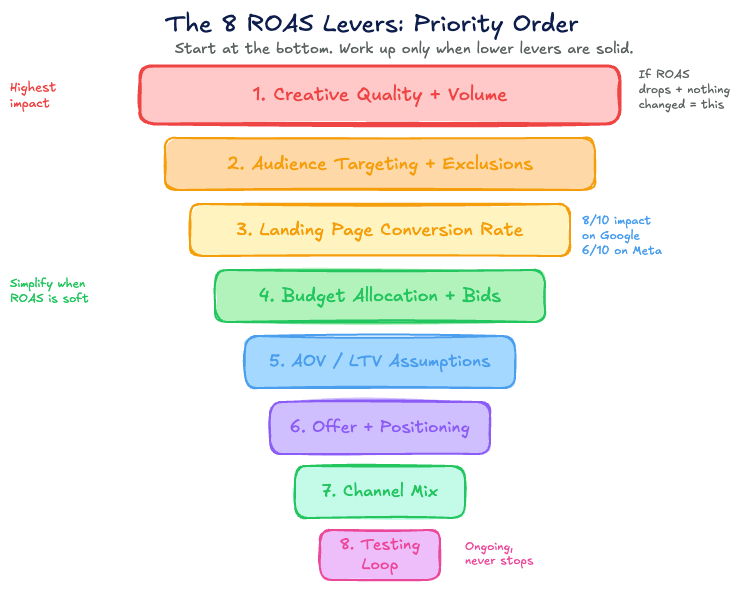
That framing matters because the advice in this article is written for a specific situation: your ROAS is below your profitability target, and you need to bring it up. Here are the eight levers I reach for, in order of how often they’re actually the problem.
How to Think About ROAS (Before Trying to Improve It)
Return on ad spend (ROAS) measures how much revenue you generate for every dollar you spend on advertising. If you spend $10,000 and drive $50,000 in revenue, your ROAS is 5x.
The target ROAS that makes sense for your business is derived from your margins. A rough example: if your gross margin is 50% and your overhead runs at about 25% of revenue, you need a ROAS of roughly 4x to hit a 25% profit target after costs. That math will be different for every business, but the principle is the same.
Your ROAS target should come from your unit economics, not from a benchmark someone posted on Twitter.
ROAS also differs from ROI. ROAS only counts ad spend. ROI accounts for everything: creative production costs, agency fees, salaries, all of it.
Both numbers matter, but they answer different questions.
Lever 1: Creative Quality and Volume
If ROAS has been declining and nothing significant has changed in your campaigns, the most likely culprit is creative fatigue. Your ads are still running. Your audience still exists.
But the creative has worn out its welcome.
Creative is the last remaining true differentiator in paid social. Meta’s Advantage+ and Google’s Performance Max have largely commoditized audience targeting. The algorithm finds your audience.
Your edge is in what you show them.
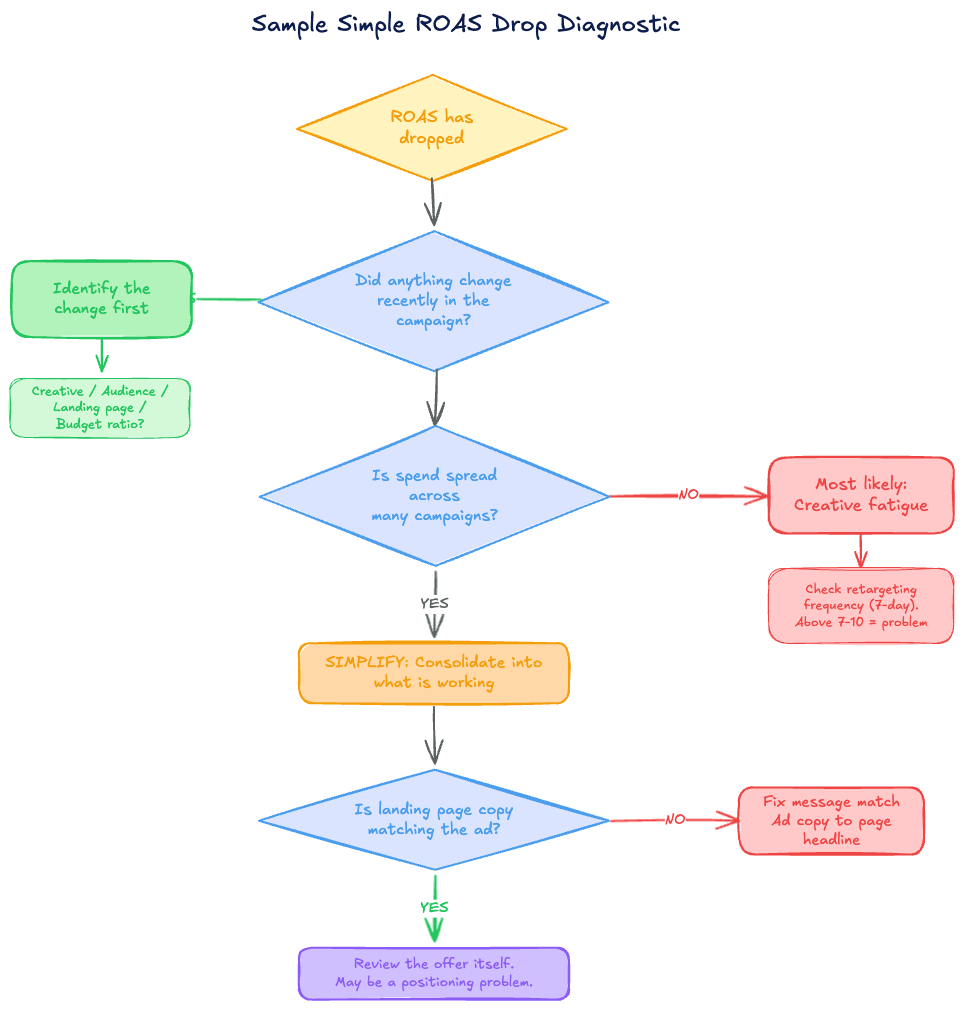
The fix for creative fatigue isn’t always to produce something brand new. When diagnosing a ROAS drop, the first thing I look at is what’s changed. Has anything in the campaign been altered recently?
If nothing has changed and ROAS has dropped, that’s almost always a creative signal. Specifically, I look at frequency: if your retargeting campaigns are showing ads to the same people seven or ten times in a seven-day window, your retargeting audience is too small for your spend level. That’s a creative and audience problem together.
On volume: for brands scaling from around $2M to $20M in revenue and running paid social, a reasonable creative testing cadence is 4 to 24 new creatives per month, so somewhere between one and six per week. Most brands fall in the middle. The goal isn’t volume for its own sake.
It’s building a system that consistently produces new winners before the current ones fatigue.
Lever 2: Audience Targeting and Exclusions
Modern ad platforms do most of the heavy lifting on audience targeting. But there are still meaningful gains available in how you structure your data inputs and exclusions.
First-party data quality matters more than ever. The better your CRM data and conversion API setup, the better signal the platform gets. Lookalike audiences built on high-quality customer lists outperform ones built on broad site traffic.
Retargeting audiences built around meaningful signals (like someone who viewed a product page twice) outperform ones built on basic site visitors.
Exclusions are often the fastest win. Stop showing ads to existing customers if you’re not running a retention campaign. Exclude recent purchasers from acquisition campaigns.
Remove converters from lead gen audiences. Wasted impressions on people who already bought are a direct drag on ROAS.
Lever 3: Landing Page Conversion Rate
ROAS is a function of two things: how well your ad performs, and how well your page converts the visitors that ad sends. Most advertisers focus almost entirely on the first one and underinvest in the second.
Landing page quality matters differently by platform. On Google, where someone is actively searching for something specific, the match between what your ad promises and what your page delivers is critical. Google will literally lower your Quality Score, increasing your cost per click, if your ad and landing page aren’t aligned.
The user intent is specific. The page has to deliver on that specificity.
On Meta, a great ad with a warmed audience can sometimes carry a weaker landing page because the intent generated by the ad is strong enough to push through. But that’s a ceiling, not a strategy. The highest-converting setups on both platforms have tight message match from ad headline to page headline to CTA.
The most impactful landing page changes I’ve seen move ROAS: fixing message mismatch between the ad and the page, reducing form fields, improving page load speed, and making the primary CTA obvious and singular.
Lever 4: Bid Strategy and Budget Allocation
One of the most common ROAS problems I see has nothing to do with creative, audiences, or landing pages. It’s that brands are spreading budget too thin.
They have one channel or campaign type that’s genuinely working. But on principle, because ‘we need to diversify,’ they’re running spend across four other things that aren’t working. When you’re struggling with ROAS, the right move is usually to simplify.
Concentrate spend on what’s profitable. Kill what isn’t. Once you’ve stabilized performance, then you add complexity back.
On bidding strategy: if you’re running target ROAS bidding, the platform optimizes toward your target, but at the cost of reach. Setting your target too high often means the algorithm finds fewer eligible impressions and you underspend. This is one of the sneaky ways high ROAS expectations actually limit revenue growth.
The system stops bidding on opportunities that might convert profitably at a slightly lower ROAS.
Lever 5: Average Order Value or Lifetime Value
Sometimes the most direct path to better ROAS isn’t cutting spend or improving targeting. It’s increasing how much each converted customer is worth.
For e-commerce, this means bundles, upsells, and free shipping thresholds that increase average order value. For service businesses and high-LTV products, it means building a conservative LTV assumption into your ROAS target rather than optimizing purely for first-purchase economics.
Most brands don’t actually know their LTV with precision. That’s normal. LTV is always a theoretical number built on cohort assumptions that keep changing.
The right move is to agree on a conservative assumption, get leadership aligned on it, and use it to set a ROAS target that reflects the true value of a customer, not just the first transaction.
Lever 6: Offer and Positioning
If you’ve worked through all the above levers and ROAS is still underperforming, the problem may not be the advertising at all. It may be the offer.
Weak offers produce weak conversion rates regardless of how good the targeting or creative is. If the value proposition on your landing page doesn’t clearly answer ‘why should I buy this, now, from you,’ no amount of optimization will fix it. Sometimes this means revisiting pricing, the guarantee, the framing of what’s included, or the comparison to alternatives.
Advertising is a magnifier. It magnifies a strong offer and it equally magnifies a weak one.
Lever 7: Channel Mix and Attribution
Not all ROAS is equal across channels. A Meta campaign might show a 3x ROAS using last-click attribution while it’s actually contributing much more through assisted conversions that close on Google. If your attribution model is last-click only, you’re likely misreading which channels are performing and which aren’t.
Set channel-specific ROAS expectations that reflect each platform’s role in your funnel. Top-of-funnel awareness channels will always look worse on last-click than bottom-of-funnel capture channels. That doesn’t mean they’re not working.
Lever 8: Testing Cadence
Improving ROAS isn’t a one-time fix. It’s a system. The brands that sustain strong ROAS over time are the ones that build a continuous loop: test creative, identify winners, scale winners, kill losers, introduce new tests.
The loop never stops.
The testing cadence you need depends on your cost per conversion. Lower cost per conversion means faster signal and more tests per month. Higher cost per conversion means slower signal and more deliberate test design.
What stays constant is the discipline to keep the loop moving.
What Is a Good ROAS?
The honest answer is: it depends entirely on your business model and margins.
For e-commerce brands with tight margins, a target ROAS of 4x to 6x is common. For service businesses or subscription products with high LTV and lower first-purchase margins, a 2x ROAS might be genuinely profitable. For lead generation, where the first conversion is an inquiry and not a sale, ROAS is often not the right metric at all.
Cost per qualified lead is more meaningful.
The framework for finding your number: start with your gross margin, subtract your overhead as a percentage of revenue, and work backward to the ROAS that keeps you profitable. That’s your floor. Revenue maximization happens above it, not below it.
Frequently Asked Questions
How do I increase ROAS on Facebook ads?
Start by diagnosing whether the issue is creative fatigue, audience quality, or a budget allocation problem. Check when you last refreshed creative and look at retargeting frequency. If the ROAS drop coincided with nothing changing in your setup, creative fatigue is the most likely cause.
How do I increase ROAS without increasing my ad budget?
Focus on the non-spend levers: improve landing page conversion rate, tighten message match between ads and pages, add exclusions to remove wasted spend on existing customers, and consolidate budget from underperforming campaigns into what’s working.
What is the difference between ROAS and ROI?
ROAS measures revenue relative to ad spend only. A 4x ROAS means you generated $4 in revenue for every $1 in ads. ROI measures profitability relative to total investment, including ad spend, production costs, salaries, and overhead.
Both matter; they answer different questions.
What is a good ROAS for paid social?
There is no universal number. A profitable ROAS for your business is derived from your gross margin and overhead structure. For most e-commerce brands, 4x to 6x is a common range.
For service businesses or subscription products, a lower ROAS may still be highly profitable. The benchmark that matters is yours, not an industry average.
How do I increase ROAS on Google Ads?
On Google, landing page relevance is critical. Tighten message match between keywords, ad copy, and landing page content. Remove negative keywords that are driving irrelevant clicks.
Review your bidding strategy and make sure your target ROAS is not set so high that the algorithm is limiting your reach unnecessarily.
If your current campaigns are hitting a profitability floor without scaling, the senior marketers at Flywheel Digital can audit your attribution intelligence and paid social strategy. They focus on maximizing revenue through practical data frameworks rather than chasing vanity efficiency metrics.