The most common student lead generation problem I see has nothing to do with targeting, budget, or channel mix.
It’s that the team is optimizing for the wrong thing. They’re chasing lead volume. More form fills.
More inquiries. More names in the CRM. And then wondering why enrollment numbers aren’t moving.
Volume isn’t the goal. Qualified volume is. A student lead that doesn’t have the right program fit, the right enrollment timeline, or any genuine intent to commit is not an asset.
It’s noise that wastes your admissions team’s time and pollutes your campaign data.
Here’s how to build a student lead generation system that actually serves enrollment goals.
What Is Student Lead Generation?
Student lead generation is the process of attracting prospective students who have real interest in a program and capturing their information so you can begin the enrollment journey with them. The key word is ‘real interest.’ Not curiosity. Not passive engagement.
Intent that has a reasonable chance of converting to an application and eventually an enrollment.
It’s different from general consumer lead generation in a few important ways. The decision cycle is long, typically a minimum of 30 days from first contact to commitment, and often several months. There are usually multiple stakeholders involved, a student, often their parents or partner, and sometimes an employer.
And the product being evaluated is high-stakes: a program that requires significant time, money, and life disruption to pursue.
That context has to shape how you build your lead generation program.
Why Volume-First Thinking Fails in Education
There’s a version of student lead generation that produces thousands of inquiries and very few enrolled students. I’ve seen it repeatedly. The form is generic.
It asks for a name and an email. The campaign targets broadly. The cost per lead looks great in the dashboard.
And then the admissions team spends weeks on the phone with people who weren’t really that interested to begin with.
When auditing education clients, the gap I find most often isn’t in the top of the funnel. It’s in how leads and enrollments are tracked as two completely separate things. Inquiries on one side, enrolled students on the other, and no connective tissue showing which channels or campaigns drove which enrolled students, how long the conversion took, or what the rate was by source.
Without that data, you can’t improve. You’re making decisions based on lead volume rather than enrollment outcomes. The solution is building your measurement framework around the full funnel, not just the first step.
The 5 Elements of a High-Quality Student Lead
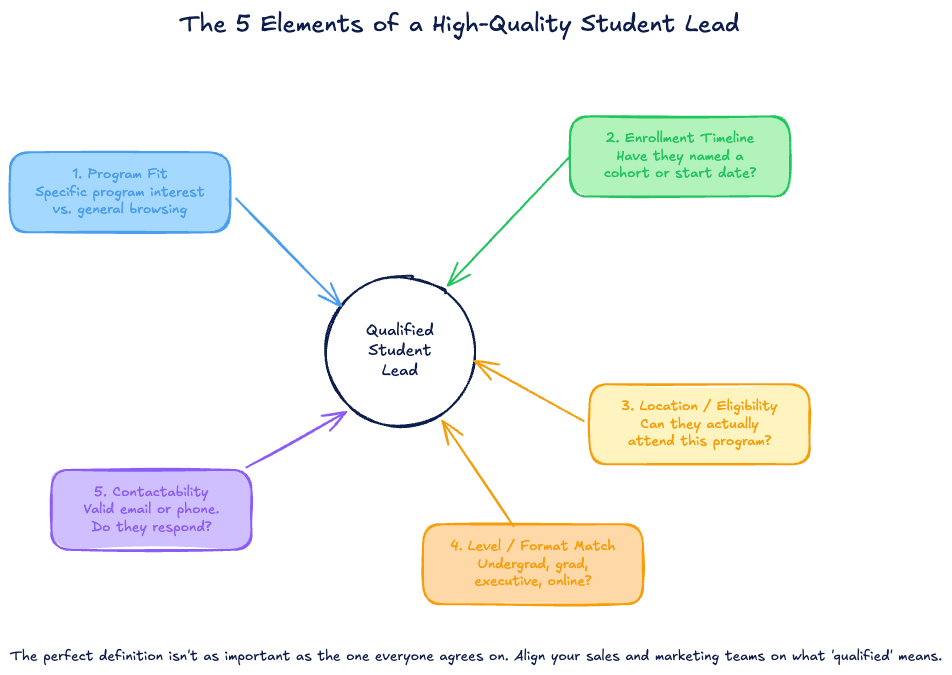
Before building any campaign, get clear on what a qualified student lead actually looks like for your program. In our work across education clients, these five factors consistently predict whether a lead has a real chance of converting:
- Program fit: Has the prospective student expressed interest in a specific program, or are they browsing broadly? Program-specific interest is a much stronger signal than general education inquiry.
- Enrollment timeline: Have they indicated when they want to start? A student who says ‘the next cohort’ is a different lead than someone who says ‘maybe in a couple years.’ Timeline is one of the single best indicators of intent.
- Location or modality eligibility: For programs with geographic restrictions or in-person requirements, a lead who can’t actually attend is not a lead. Filter for this early.
- Level or format match: Graduate, undergraduate, continuing education, online, hybrid. A mismatch here creates friction downstream. Capture this at inquiry rather than discovering it during admissions calls.
- Contactability: A valid phone number or email address that the student actually engages with. A lead you can’t reach is a lead you can’t convert.
The simplest way to capture this data is to build it into your inquiry form. Not all at once, but as part of a progressive profiling strategy: ask for the most important signals upfront (program interest, timeline, location) and gather the rest through follow-up.
Building the Lead Capture System
Your lead capture infrastructure is the difference between qualified leads and lead-shaped noise.
The most common mistake is a form that’s either too long or too generic. Too long creates friction and reduces conversion rate. Too generic, with just name and email, gives you names but no qualification data.
The right form is short enough to submit on mobile in under a minute and specific enough to give you the signals you need to qualify the lead.
For most education programs, three to four fields at initial capture is the target: program interest, enrollment timeline, location or country, and email. That’s enough to qualify and route the lead without creating enough friction to kill conversion.
Meta and LinkedIn Lead Ads are worth testing for any digital-first education program. Because they pre-fill contact information from the user’s profile, friction at the form level drops significantly, and conversion rates on lead ads tend to outperform landing page forms. The trade-off is less flexibility on form design and slightly lower intent signals since the barrier to fill is lower.
Routing matters as much as capture. Leads should flow directly into your CRM (HubSpot, Salesforce, or equivalent) with program, timeline, and source tagged automatically. If your admissions team is manually sorting inquiries into program buckets, that’s both a time sink and a data quality problem.
Build the routing into the system.
Paid Media for Student Lead Generation
Paid media is the fastest way to generate consistent student demand for digital-first programs. The channel mix depends on your program type, budget, and audience.
Meta is typically the strongest channel for top-of-funnel volume and awareness-stage lead generation. It reaches broad audiences efficiently, and with the right creative and a well-structured lead form, cost per inquiry can be competitive. It works especially well for programs with broader audience pools: online learning, career prep, professional development.
Google Search is the right channel for high-intent, near-decision queries. Someone typing ‘online MBA program Canada’ into Google is further along in their decision process than someone who saw your ad on Instagram. The conversion rate is typically higher, but the volume is lower and cost per click is higher.
For programs with specific, searchable intent, Google Search should be in the mix.
Flywheel’s 2026 Education Advertising Benchmark Report breaks down channel mix and cost-per-lead benchmarks by vertical. For career prep programs (typically $5,000 to $15,000 price points), Google Search takes the largest share of spend because prospective students research career decisions heavily before committing. Top performers in career prep are achieving cost per lead of around $60, with a 60% SQL rate and cost per enrolled student of approximately $1,000.
For online learning (typically $100 to $699 price points), Meta dominates because the path from ad to purchase is shorter and social creative does the heavy lifting. Top performers there are hitting cost per lead of around $10, with cost per customer around $35. Higher education sits between those poles, with a more even channel split and top performers achieving cost per lead around $25 and cost per enrolled student around $300.
For the full breakdowns, the full report is at flywheel.digital/education-benchmark-report/.
Creative for education lead generation tends to perform best when it’s specific rather than aspirational. ‘Study 3D animation at Think Tank‘ outperforms ‘Launch your creative career.’ Outcome-driven messaging and specific program details tend to attract students who are genuinely considering that program, which is exactly the filtering effect you want.
Nurturing Leads Through the Enrollment Cycle
Capturing the lead is not the finish line. It’s the start of a process that typically takes weeks or months to complete.
Right now, one of the biggest conversion gaps in education lead generation is student hesitation. There’s a lot of genuine anxiety among prospective students about career decisions, program costs, and whether it’s the right time to commit. Many are looking, genuinely interested, but not yet ready to move.
The institutions that win are the ones that create urgency: here’s why now is the right time. That might be a pricing deadline, a cohort that’s filling up, or a broader ‘why delay costs you’ argument. Whatever the mechanism, helping students understand why acting now matters is one of the highest-leverage things in the nurture sequence.
The moment someone submits an inquiry form, the first touchpoint should be immediate. Not ‘thanks, you’ll hear from us.’ A real response: here’s the information you asked for, here’s how to book a call, here’s how to take the next step. Every email in the nurture sequence should give the student a way to accelerate.
Don’t make them wait through a drip series to find the option to apply.
Nurture sequences typically run two to four weeks for most education programs. The content mix should include:
- Information delivery: Give them what they asked for, delivered clearly
- Next step clarity: Every email should have one clear action, whether it’s booking a call, starting an application, or attending an info session
- Storytelling: Alumni outcomes, instructor profiles, student stories. This is what sticks and what students use to convince themselves and the people around them that this decision is the right one
On that last point: every student has to sell this decision to someone. Their partner, their parents, their employer. The nurture sequence should arm them with the story, the data, and the emotional case for why this program is worth it.
You’re not just convincing the student. You’re giving them what they need to convince everyone else.
How to Measure Student Lead Generation ROI
The core metric chain for education lead generation runs from cost per inquiry to cost per application to cost per enrolled student.
Cost per enrolled student is the number that actually matters to the business. Everything else is a leading indicator. The reason to track cost per inquiry and cost per application is to understand where in the funnel efficiency is breaking down.
Strong lead generation programs also have a data feedback loop. When a lead converts to a call booking or an application, that event should flow back into your ad platform through the Conversions API or your CRM integration. This closes the loop between marketing spend and downstream enrollment outcomes, and it gives the platform better signal to optimize toward.
Without that feedback loop, you’re optimizing for form fills. With it, you’re optimizing for the students most likely to actually enroll. That’s a materially different campaign.
Frequently Asked Questions
How do you generate student leads for higher education?
The most effective student lead generation programs combine paid media (Meta for volume, Google Search for high-intent queries) with a clear lead capture form that collects qualification data, a CRM-integrated routing system, and a structured nurture sequence. The goal is qualified leads, not just volume.
How much should I pay for student lead generation?
Cost per student lead varies significantly by program type. Based on Flywheel’s 2026 Education Advertising Benchmark Report, top performers in online learning achieve cost per lead around $10, career prep programs around $60, and higher education around $25. Averages run higher across all three segments.
The more important number than cost per lead is cost per enrolled student, which the report also benchmarks by vertical. Full data at flywheel.digital/education-benchmark-report/.
What does student lead generation mean?
Student lead generation is the process of attracting prospective students with genuine interest in a program and capturing their contact information and qualification data so you can begin the enrollment journey. Quality matters more than volume: a smaller number of well-qualified leads produces more enrolled students than a large number of unqualified ones.
How can institutions measure the quality of student leads?
Track conversion rates at each funnel stage: inquiry to call, call to application, application to enrolled student. Segment by channel, campaign, and program to identify where quality is high or low. Build feedback loops from your CRM back to your ad platform so you’re optimizing for downstream enrollment events, not just form fills.
What role does paid media play in student lead generation?
Paid media is typically the fastest channel for generating consistent student demand, particularly for digital-first and online programs. Meta drives top-of-funnel volume efficiently. Google Search captures high-intent students actively researching programs.
The right mix depends on your program type and audience size.
If your team is struggling to separate genuine intent from CRM noise, the Flywheel enrollment marketing team embeds senior strategists to fix your attribution and lead quality. They use a data-driven framework to ensure your paid social and search budgets prioritize actual enrollments over empty form fills.