Most enrollment marketing problems aren’t creative problems. They’re planning problems.
I’ve audited enough education marketing programs to know the pattern: a busy team running campaigns without a documented plan, measuring leads and enrollments as two separate numbers that never talk to each other, and wondering why the conversion rate feels like a mystery. The fix isn’t a better ad. It’s a better plan.
Here’s how to build an enrollment marketing plan that connects the dots from first inquiry to enrolled student, and gives you a framework you can actually act on.
What Is Enrollment Marketing (and What It’s Not)
Enrollment marketing is performance marketing for education. Where an e-commerce business defines performance as revenue, education brands define performance as driving enrollments. The goal is the same: take someone from awareness to conversion. The conversion is just a seat in a program instead of a product in a cart.
It’s worth being clear about what enrollment marketing is not. It’s not brand marketing, which focuses on the school’s identity and awareness at a broad level. It’s not recruiting, which tends to mean active outreach at booths and fairs. Enrollment marketing is the digital, performance-driven system that moves prospective students from initial interest through to application and enrollment.
If you’re measuring the right things and your plan is built around the right goals, enrollment marketing is one of the highest-leverage investments an education brand can make.
Why Most Enrollment Marketing Fails Without a Plan
When there’s no documented plan, education marketers tend to do one of two things: they react to whatever leadership is worried about this week, or they copy what they think a competitor is doing and hope it works.
Both approaches produce the same result. Campaigns that overlap or contradict each other. Vendors running in parallel with no shared strategy. Audiences that aren’t well-defined. And when results disappoint, no baseline to compare against.
The biggest gap I see when auditing new education clients isn’t creative quality or budget size. It’s this: they track leads and enrollments as two completely separate metrics. Leads over here, enrollments over there, with no real understanding of how one becomes the other. They can’t see conversion rates by channel, time to convert, or which sources actually drive enrolled students versus just inquiries. You can’t improve what you can’t connect.
A plan forces you to make those connections before you spend a dollar.
Step 1: Establish Your Baseline Metrics
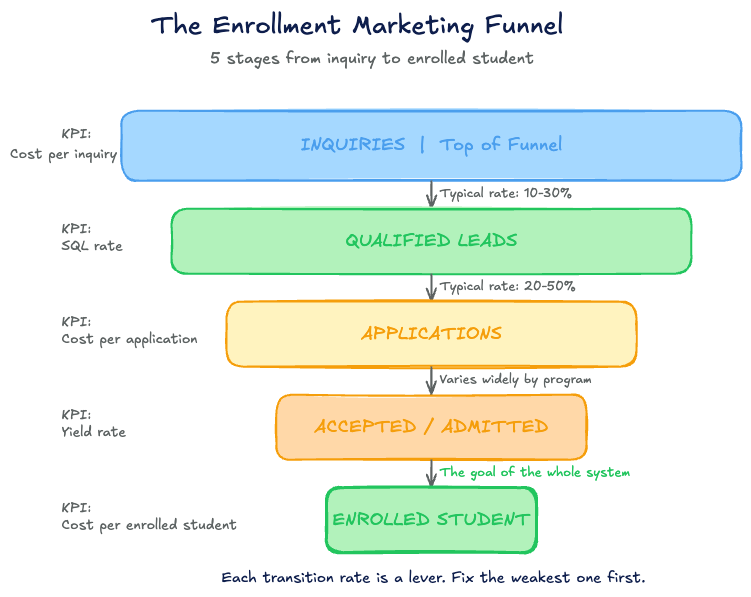
Before you set a single goal, you need to understand where you’re starting. Your baseline is the data from your most recent enrollment period: how many inquiries did you generate, how many of those became applicants, and how many applicants became enrolled students?
The metrics that matter at each stage of the funnel are:
- Inquiries: Total leads or form fills by channel
- Cost per inquiry: What you spent to generate each one
- Inquiry-to-application rate: What percentage moved to the next step
- Application-to-enrollment rate: Your conversion from applicant to enrolled student
- Time to convert: How long, on average, it took from inquiry to enrollment
Most programs have the first metric. Very few have all five. Getting the full picture is what allows you to identify where the real problems are. A low inquiry volume is a top-of-funnel problem. A low application rate is a nurture problem. A low enrollment rate is usually an admissions or offer problem.
Step 2: Define Your Audience by Program
One of the trickiest parts of enrollment marketing, especially for institutions with multiple programs, is resisting the urge to treat all students the same.
A prospective undergraduate student and someone considering an executive education program are not the same person, don’t search the same way, and don’t need the same message. If your marketing plan doesn’t account for this, you’ll end up with generic campaigns that convert at generic rates.
The better approach is to map your programs and understand the search intent behind each one. Often, programs are named internally in ways that don’t match what a prospective student would actually type into Google. We worked with Think Tank (tttc.ca), a creative arts school with a range of programs touching on 3D animation, VFX, and character design. What students actually searched for was something like ‘CG character creation course.’ Not the program name. The student’s intent, not the institution’s taxonomy, has to drive how you build your campaigns.
Start here: for each program, ask what outcome or skill a student is searching for. Build your audiences and campaign structure around that.
Step 3: Set SMART Goals by Funnel Stage
Overall enrollment targets are set by leadership. Your job as a marketer is to translate that target into specific, measurable goals at each stage of the funnel.
If you need 200 enrolled students and your historical inquiry-to-enrollment rate is 5%, you need 4,000 inquiries. If your cost per inquiry is $50, that’s a $200,000 top-of-funnel budget requirement. That’s the kind of math a plan makes possible. Without it, you’re guessing.
Set goals for each stage: inquiries, applications, and enrolled students. Then add a conversion rate goal for each transition. These don’t need to be aggressive. Conservative goals you can hit and improve on are more valuable than ambitious ones you can’t defend.
Step 4: Build Your Campaign Calendar
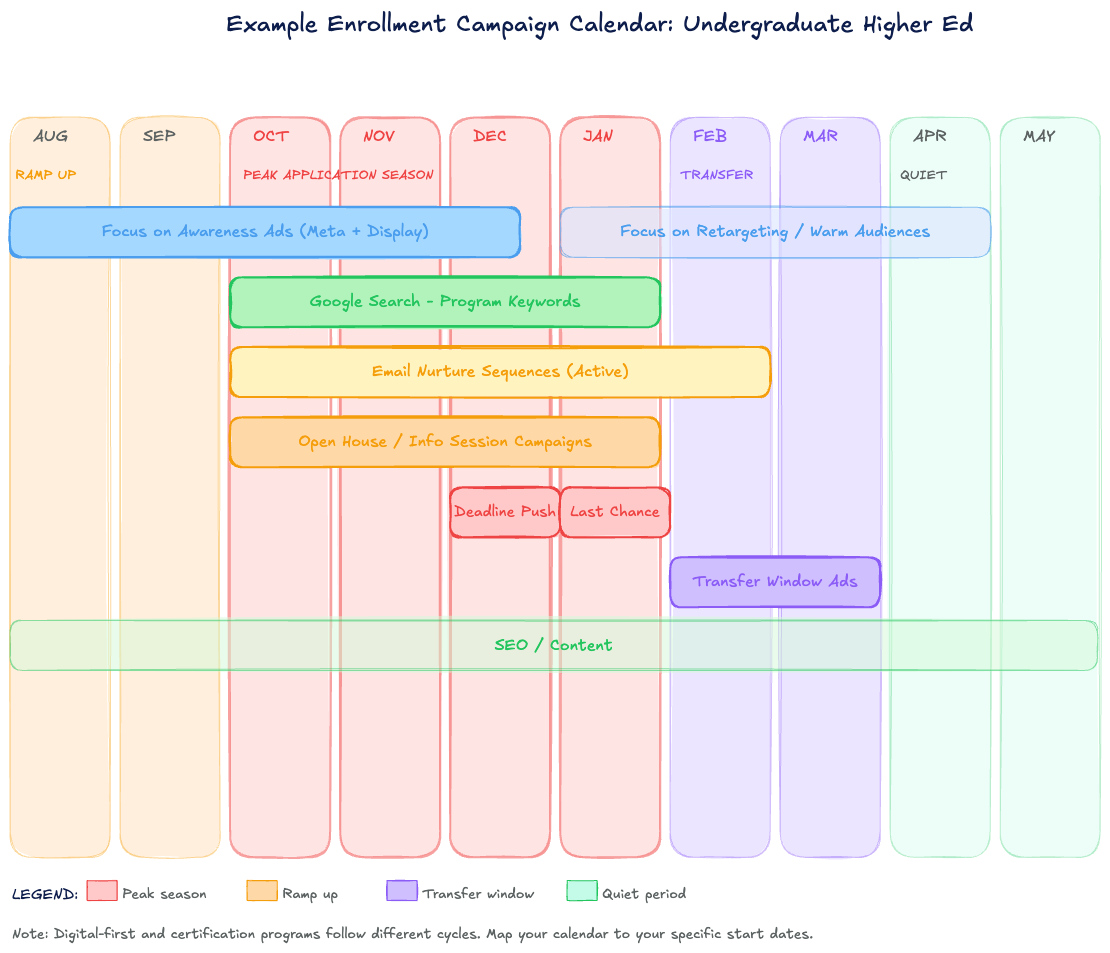
The timing of your enrollment marketing is just as important as the content of it. Every program has a natural rhythm, and your campaign calendar should map to that rhythm, not work against it.
For undergraduate higher education in North America, the pattern is fairly predictable: ramp up marketing in August and September, peak through the application window from October to January, handle transfer inquiries in February and March, and pull back in late spring. For admissions consulting programs, the cycle shifts back a month or two as students prepare earlier.
For online and certification programs, the calendar is more variable. It often depends on cohort start dates, professional credit cycles, or certification windows. What we’ve found with digital programs is that a significant portion of enrollments, sometimes 50% of a cohort’s revenue, come in the final 30 days before a program starts. That last-minute sprint is real and needs to be built into your plan.
We work with MBA Mission, which helps students get into top MBA programs. A key part of their marketing calendar is sharing specific school application deadlines directly in their communications, so prospective clients can plan backward. That kind of deadline-driven content is both genuinely useful and highly effective at creating urgency.
When building your calendar, map campaigns to enrollment deadlines and build in urgency windows. ‘Last chance’ and ‘applications close Friday’ messaging works, but only if you’ve planned for it.
Step 5: Choose Your Channels (After the Plan)
Channel selection should come after you’ve established your baseline, defined your audiences, set your goals, and built your calendar. Not before.
The channel choices available to education marketers are well-known: Meta ads for top-of-funnel awareness and lead generation, Google Search for high-intent program queries, email for nurture sequences, and SEO for long-term organic acquisition. Each has a role. The right mix depends on your program type, your budget, and where your students actually are.
For lean teams, the minimum viable setup is this: one paid channel that generates qualified inquiries, one top-of-funnel informational offer (a program guide, a webinar, a student outcomes report), and an admissions function that thinks like sales. That’s the foundation. Everything else builds on it.
What you can skip, at least early on, is the instinct to run integrated marketing campaigns across every channel simultaneously. Trying to synchronize digital with TV or out-of-home before your digital program is performing limits your ability to test and learn. Digital enrollment marketing is built on testing creative and finding what works. Lock yourself into a fixed campaign message too early and you’ve hobbled that process.
How to Measure and Iterate
Your plan is only useful if you revisit it. Set a cadence, monthly at minimum, to compare your actual performance against your baseline metrics and goals. The questions to ask are: Is my inquiry volume on pace? Is my inquiry-to-application rate improving or declining? Which channels are driving enrolled students, not just leads?
When you build your plan around connected funnel metrics, these questions become answerable. That’s the difference between a program that learns and improves and one that runs the same campaigns year after year and wonders why results don’t change.
Frequently Asked Questions
What is an enrollment marketing plan?
An enrollment marketing plan is a documented strategy that maps the steps from initial inquiry to enrolled student. It includes baseline funnel metrics, audience definitions, stage-by-stage goals, a campaign calendar, and channel mix. Unlike general marketing plans, it focuses specifically on driving measurable enrollment outcomes.
What techniques can make your school enrollment marketing plan more effective?
The highest-impact technique is connecting your lead data to your enrollment data so you can measure conversion rates by channel and time to convert. Beyond that: segment campaigns by program rather than marketing to all students the same way, build your calendar around enrollment deadlines, and include at least one top-of-funnel informational offer to capture early-stage interest.
What is the difference between enrollment marketing and admissions marketing?
Enrollment marketing refers to the full performance-driven system for attracting and converting prospective students, primarily through digital channels. Admissions is the downstream process that turns applicants into enrolled students. They’re related but distinct: enrollment marketing fills the funnel, admissions works the leads.
How do I measure the ROI of enrollment marketing?
The core metric is cost per enrolled student, which you calculate by dividing total marketing spend by the number of new enrollments attributable to that spend. Supporting metrics include cost per inquiry and cost per application. The key is connecting your marketing data to your enrollment data so you can trace which channels and campaigns actually produced enrolled students.
How much should I spend on an enrollment ad campaign?
There’s no universal answer, but there is a useful formula. Start with your enrollment target, work backward through your funnel conversion rates to determine how many inquiries you need, then multiply by your cost per inquiry benchmark for your program type and channel mix. For detailed benchmarks by education vertical, Flywheel’s Education Advertising Benchmark Report is a useful reference.