Key Takeaways
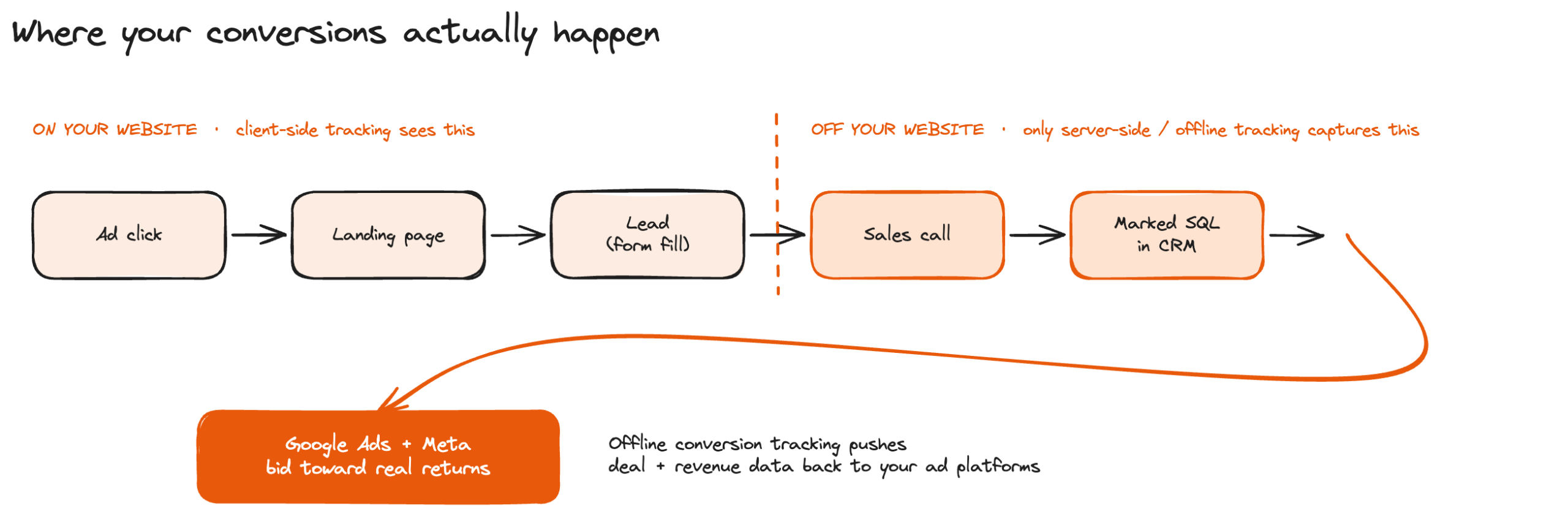
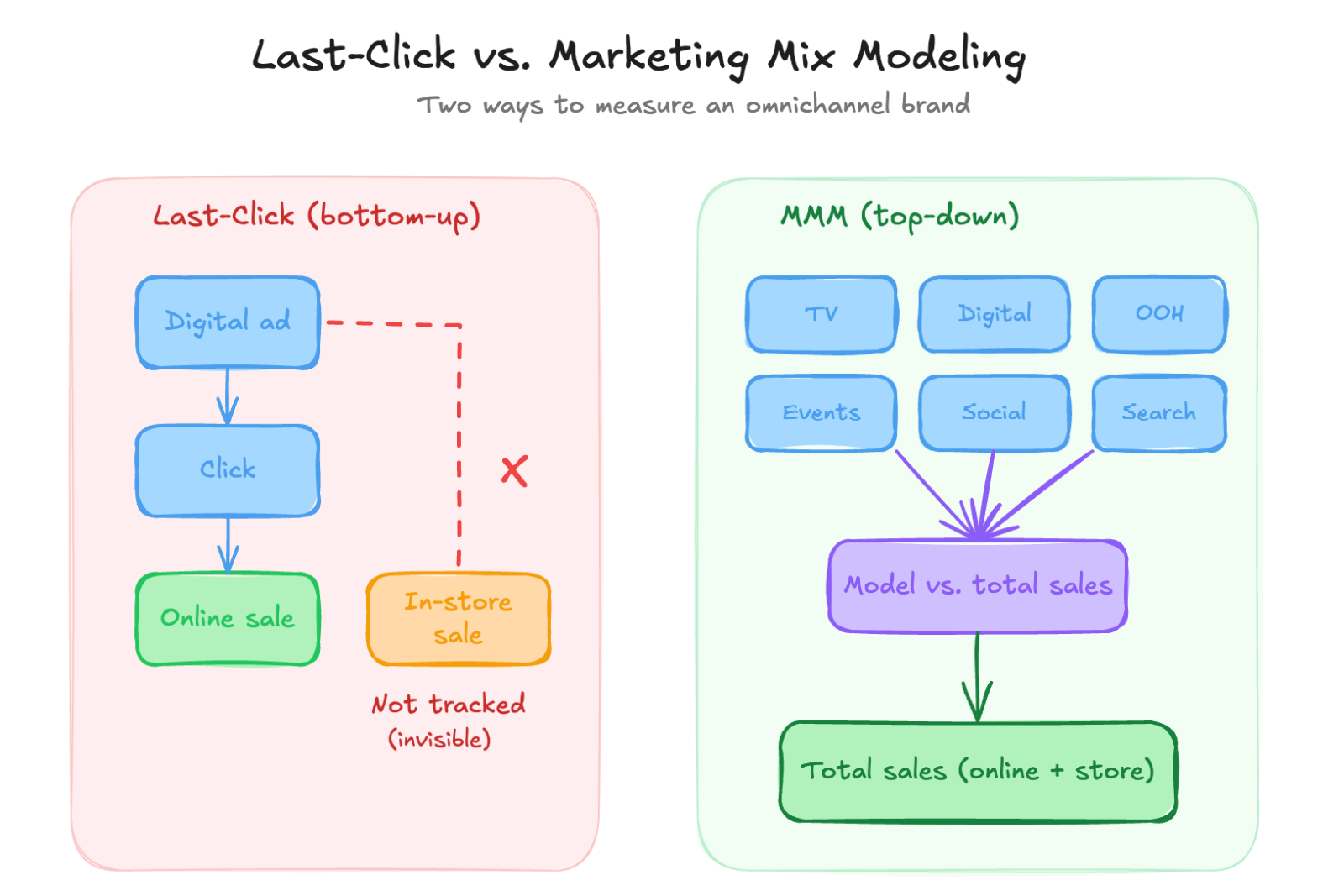
- Most attribution models are built around the click, which captures only a fraction of how consumers actually engage with brands.
- The right attribution model depends on your channel mix, what your team agrees on, and whether you’re evaluating a single channel or comparing across channels.
- Businesses under $10M in revenue generally don’t need to overthink attribution model selection, as long as their tracking is solid and they have clear profitability constraints.
- The ultimate source of truth is always the ratio of revenue to marketing spend (AMER), not what any single platform reports.
Why Most Marketing Analytics Are Misleading
Most marketers fundamentally misunderstand how marketing analytics works, and Google Analytics is largely to blame.
Google Analytics popularized a measurement model where success is defined entirely by who visits your website, how they got there, and what they did once they arrived. That model made sense when search ads and email were the primary digital channels. It makes far less sense in 2026.
The problem is simple. In a modern marketing ecosystem, the majority of touchpoints someone has with your brand don’t involve clicking through to your website. A customer might see your ad five times on Instagram before they ever click. They might open an email, forget about it, then Google your brand name a week later. They might hear about you on a podcast, check your social profiles, and then type your URL directly into their browser.
In every one of these scenarios, the thing that actually influenced the purchase is invisible to click-based attribution. The “credit” goes to whatever generated the final click, usually a Google search or a direct visit.
Think about how you engage with brands as a consumer. How often does a single website visit drive your purchasing decision? Rarely. Most of the time, there are multiple touchpoints, many of them non-click, that build familiarity and trust before you ever convert. Attribution models that only see the click are missing most of the picture.
This disconnect is why so many marketing reports generate more confusion than clarity. And it’s why choosing the right attribution model matters less than understanding what any model can and cannot tell you.
How to Choose an Attribution Model: Three Questions to Ask
When a new client comes to Flywheel Digital, we don’t start with the model. We start with three questions that determine how much attribution complexity the business actually needs.
What Does Your Channel Mix Look Like?
The complexity of your channel mix determines how complex your attribution needs to be.
If you’re an e-commerce brand that drives the majority of revenue through social ads, you can often use a relatively simple model. Look at your cost per acquisition in-platform on a one-day click basis, make sure your CAC targets are being hit, and you’re in solid shape. The platform-level view is close enough to reality.
But if you have a large email list, significant brand awareness, a multi-touch sales process, or you’re running campaigns across five or six channels simultaneously, the in-platform CAC won’t tell the full story. You’ll need a model that accounts for how those channels interact.
What Does Everyone Agree On?
No attribution model is perfect. Every one of them requires assumptions and trade-offs. One of the most practical things you can do, especially for organizations that have been running marketing programs for years, is simply pick a model that the entire team agrees on and commit to it.
If your organization has used first-click attribution for five years, there’s very little upside to switching to last-click, even if you think last-click is more “accurate.” Accuracy is relative in attribution. Consistency and organizational alignment are more valuable than theoretical precision.
The conversation sounds like this: “We all agree no attribution model is perfect, but this is the one we’ll use to make decisions. We’ll apply it consistently, and we’ll evaluate trend changes over time, not absolute numbers.”
What’s the Goal of This Model?
Attribution models serve different purposes depending on what you’re trying to understand.
Comparing the effectiveness of different channels against each other is one goal. Evaluating the performance of a single channel on its own is a very different one. An ads-focused model might look at cost per acquisition within Meta or Google. An SEO-focused model might look at organic traffic trends, conversion rates from organic sessions, and revenue attributed to organic entry points.
Conflating these goals is one of the most common attribution mistakes we see. Before picking a model, decide what question you’re trying to answer.
The Two Levels of Attribution Every Marketer Needs
At Flywheel, we think about attribution at two levels. Understanding this distinction is the single most important concept for marketers to grasp.
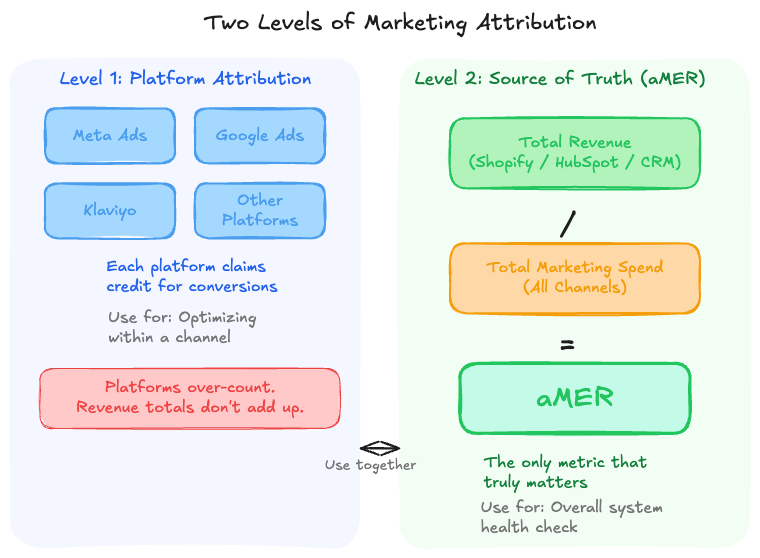
Level 1: Platform Attribution
This is what Meta, Google Ads, Klaviyo, or any other platform tells you about its own performance. It shows your cost per lead, cost per sale, return on ad spend (ROAS), and other metrics as calculated by that platform’s tracking.
Platform attribution is useful for optimizing within a channel. If you’re running Meta ads, Meta’s reported cost per acquisition is a good signal for whether your campaigns are getting better or worse over time.
But platform attribution has serious limitations. Conversion events can fire twice, revenue values can include or exclude shipping inconsistently, and attribution windows can create wildly different pictures of the same data. Technical setup issues alone can completely break platform-level reporting.
More importantly, platforms are incentivized to take credit for conversions. Meta will attribute a sale to an ad if someone clicked it within a certain window, even if that person was already going to buy. This is where the second level becomes essential.
Level 2: Source-of-Truth Attribution (AMER)
The only metric that truly matters is your advertising marketing efficiency ratio (AMER): the ratio of total revenue coming in the door compared to total marketing or advertising spend.
This number comes from your source of truth for revenue, whether that’s Shopify, HubSpot, your CRM, or your accounting system, compared against your total marketing investment.
AMER strips away the noise. It doesn’t matter which platform is claiming credit for what. What matters is: you spent X on marketing, and Y revenue came in. Is that ratio sustainable and improving?
The challenge is that AMER doesn’t tell you where to allocate your next dollar. That’s where platform attribution becomes a useful complement. The two levels work together: AMER tells you if the overall system is healthy, and platform attribution helps you make tactical optimization decisions within each channel.
Flywheel’s marketing analytics practice is built around helping clients establish and maintain both of these levels.
Understanding Incrementality
Here’s an idea that sounds complicated but is actually common sense.
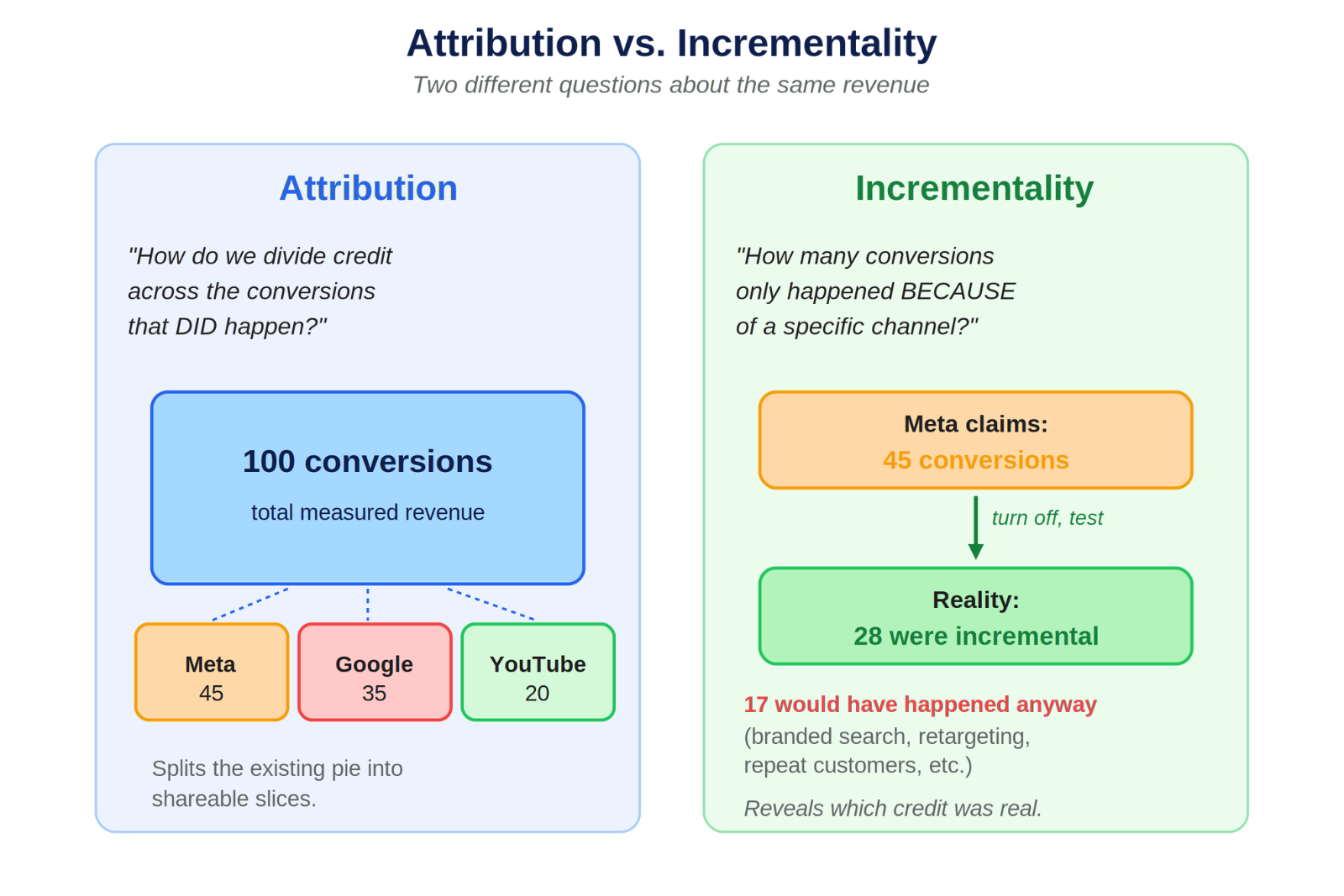
Whatever any platform reports as its results, some of those results would have happened anyway, even if that channel was turned off.
Imagine your email platform reports that your latest campaign generated $100,000 in revenue from 100 purchases. Some of those 100 buyers would have bought regardless. They saw an ad on social media. They were planning to visit your site anyway. They would have caught the sale through organic social or through a friend’s recommendation. Those purchases are non-incremental.
The same logic applies in reverse. When someone Googles your brand name, clicks your branded search ad, and buys, the vast majority of those people, somewhere between 80% and 100%, would have found you and purchased without the ad. That branded search revenue is almost entirely non-incremental.
Compare that to someone searching a generic category term, clicking your non-branded search ad, and converting. Maybe 90% of those people would never have found you otherwise. That revenue is highly incremental.
You don’t necessarily need to build incrementality assumptions into a mathematical model. But you do need to be keenly aware of them when reviewing reports and setting targets. If you know your branded search campaigns are mostly non-incremental, you should set higher ROAS targets for those campaigns to account for the fact that most of that revenue was coming in regardless.
You can also use holdout tests or campaign pause tests to get a more concrete sense of incrementality for specific channels. But even without formal testing, applying common sense to what’s incremental and what’s not will dramatically improve how you interpret your data.
When Attribution Model Selection Doesn’t Really Matter
Not every business needs to agonize over which attribution model to use. Here’s a practical rule of thumb.
If your business is under $10 million in annual revenue, the specific model you choose, whether first-click, last-click, linear, or data-driven, is unlikely to materially change your decision-making. What matters at that stage is having your conversion tracking set up correctly, being able to trust your basic cost per acquisition numbers, and having a clear constraint for profitability (your AMER target).
The model selection becomes genuinely important in two scenarios. First, when you cross roughly $10 million in revenue and the marketing mix is complex enough that different models would lead to meaningfully different budget allocation decisions. Second, if you have a very long sales cycle, like B2B SaaS or higher education, where a last-click model might heavily overweight the final touchpoint and send you in the wrong strategic direction.
For everyone else, pick a model, agree on it, and spend your energy on execution rather than attribution philosophy.
How Unified Data Platforms Change the Game
One of the biggest practical challenges with attribution is that data lives in silos. Meta has one version of your revenue. Google Ads has another. Shopify has the actual number. And none of them agree.
At Flywheel, we use Funnel as our marketing data platform to solve this problem for our clients. Funnel ingests data from every source: revenue from Shopify or HubSpot (the source of truth), ad spend and metrics from Facebook and Google, and performance data from email, SEO tools, and other channels.
The power of this approach is consistent data definitions. When you’re comparing Facebook purchases to Google purchases to organic leads, you’re comparing apples to apples because the data has been normalized. This consistency also makes the data usable for AI-powered analysis. Funnel’s built-in AI tools, which they call Data Chats, can perform robust cross-channel analysis because the underlying definitions are clean.
Without that unification, AI analysis of marketing data tends to break down quickly. A model can analyze one platform’s data reasonably well, but comparing across platforms where “purchase” might mean different things requires the data plumbing that a tool like Funnel provides.
When we started orienting our e-commerce clients around Shopify-sourced revenue instead of platform-reported revenue, something interesting happened: clients started paying significantly more attention to the reports. When the number at the top matches what they see in their bank account, the dashboard feels real.
For a deeper look at how Flywheel approaches marketing measurement, explore our marketing analytics services.
Frequently Asked Questions
What is the simplest attribution model for small businesses?
For most small businesses, tracking your cost per acquisition within your primary advertising platform (Meta or Google) and monitoring your overall AMER, the ratio of total revenue to total ad spend, is sufficient. Don’t overcomplicate it until your marketing mix demands more sophistication, typically around the $10M revenue mark.
What’s the difference between first-click and last-click attribution?
First-click attribution gives full credit to the first touchpoint that brought someone to your site. Last-click gives credit to the final touchpoint before conversion. Neither is “right.” First-click tends to favor awareness channels like social media. Last-click tends to favor search and direct. The key is consistency, not precision.
How do I know if my platform attribution is inaccurate?
Compare your platform-reported revenue to your source of truth (Shopify, HubSpot, or your CRM). If the sum of all platform-reported revenue significantly exceeds your actual revenue, your platforms are over-counting, which is extremely common. Technical audits of conversion event setup should be a regular practice.
What is AMER in marketing?
AMER stands for advertising marketing efficiency ratio. It’s the simplest and most important metric for evaluating marketing performance: total revenue divided by total marketing spend. Unlike platform-specific ROAS, AMER gives you a view of the entire system’s health regardless of which channels are claiming credit.
When should I hire an agency to help with attribution?
Consider outside help when your marketing mix spans three or more channels, your platform-reported numbers don’t match your actual revenue, or your leadership team can’t agree on how to evaluate marketing performance. An experienced growth marketing agency can often resolve these issues faster than building the capability internally, especially for mid-market companies.
If your team is struggling to reconcile platform data with actual revenue, the Flywheel attribution intelligence team builds frameworks that prioritize your total marketing spend ratio over misleading click-based metrics. Our senior strategists embed directly into your workflow to ensure your channel mix is measured against real profitability constraints.