Key Takeaways
- Education purchases are uniquely tied to identity and career, which makes the marketing funnel fundamentally different from consumer or B2B funnels.
- The typical journey runs from information lead to application to enrollment, with timelines ranging from one month (executive programs) to six months (undergraduate degrees).
- Most institutions lose prospective students by not offering engagement points between “browse the website” and “submit an application.”
- There’s a hidden funnel happening outside your website, where AI tools and Google’s AI Overviews surface program details (sometimes inaccurately), influencing decisions before a student ever visits your site.
Why Education Marketing Is Fundamentally Different
Education is not an impulse purchase. It’s not even a considered purchase in the way most marketers use that term. Choosing an educational program is one of the most identity-driven decisions a person will make.
When someone enrolls in a program, they’re not just buying a service. They’re saying, “This is what I care about. This is who I want to become. This is the direction I’m taking my career.” That emotional weight changes everything about how the enrollment marketing funnel needs to work.
Compare it to buying a t-shirt. You don’t need to buy your t-shirt from a t-shirt expert. You just need it to look good. Education is the opposite. Students need to learn from someone they trust as an expert. The credibility and perceived expertise of the institution, the program, and increasingly the specific instructors all matter deeply to prospective students making this decision.
This dual dynamic, identity-driven decisions and expertise-dependent trust, means that student acquisition tactics borrowed from e-commerce or SaaS rarely translate. And one of the most damaging things an education institution can do is hire an agency or marketer with a pure e-commerce background who tries to run the enrollment funnel like a product funnel.
At Flywheel Digital, education is a core vertical. We work with institutions including SFU, UBC, University of Victoria, McMaster, and Stanford, among others. Here’s what I’ve learned about building education marketing programs that actually drive enrollment.
The Three Stages of the Higher Education Funnel
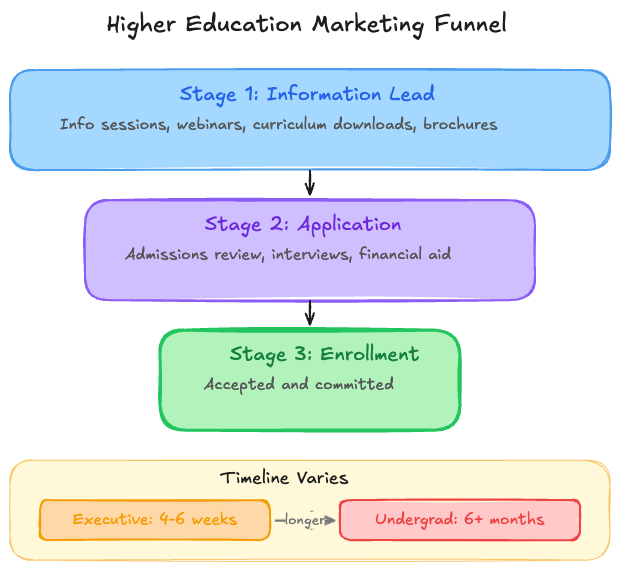
While every institution has its own variations, the education marketing funnel can be simplified into three key stages.
Stage 1: Information Lead
This is the first moment of meaningful engagement. The prospective student has moved beyond casual browsing and taken an action that says, “I want to learn more about this program.” That action might be attending an info session, joining a webinar, downloading a curriculum package, or requesting a brochure.
The critical distinction is that this person has not yet decided to apply. They’re in exploration mode, gathering information, comparing options, and often trying to figure out whether this type of program is even the right path for them.
Many institutions underinvest in this stage. Their websites are essentially program description pages followed immediately by an application link. There’s no intermediate step, no way for a curious person to raise their hand without committing to a formal application process.
Stage 2: Application
The prospective student has decided to pursue your program and has either started the application process or is actively engaging with your admissions team. In sales terminology, this is your sales-qualified lead (SQL).
The application stage is where institutional processes take over. Admissions teams review materials, conduct interviews, make offers. For many programs, this is also where financial aid conversations happen, which can either accelerate or stall the enrollment journey significantly.
Stage 3: Enrollment
The student has been accepted and has officially committed, whether by accepting an offer, paying a deposit, or registering for courses.
Between application and enrollment, the admissions team plays a much larger role than most institutions realize. This isn’t a passive waiting period. Active admissions outreach, personalized communication, and guided support through the decision process can dramatically improve conversion rates from accepted applicant to enrolled student.
Timeline Variations
These three stages can compress or expand dramatically depending on the program type. For executive MBA programs or professional certifications, the entire journey from first inquiry to enrollment might happen in four to six weeks. Students in these programs tend to be mid-career professionals who make decisions quickly once they have the right information.
For undergraduate degrees, the funnel can stretch to six months or more. High school students and their parents research extensively, visit multiple campuses, compare financial aid packages, and often apply to several institutions simultaneously.
Understanding where your program falls on this timeline spectrum is essential for setting realistic conversion expectations and building appropriate nurture sequences.
The Two Places Most Institutions Lose Students
After working with dozens of education clients, two consistent drop-off patterns emerge.
No Engagement Between Browsing and Applying
Most higher education websites follow a linear structure: here’s our program information, and here’s the application. That’s it. Two options: keep browsing or commit.
This is like a real estate agent who shows you a house and then immediately asks for your signature on a purchase agreement. The missing middle, the info sessions, curriculum downloads, webinars, admissions chats, email nurture sequences, is where the majority of interested prospects need to spend time before they’re ready to apply.
Institutions that offer multiple engagement pathways between “I’m interested” and “I’m applying” consistently outperform those that don’t. Every engagement point serves a dual purpose: it gives the student useful information, and it gives the institution permission to continue the conversation through further marketing.
Admissions Teams That Inform but Don’t Guide
Many admissions teams are trained to answer questions and provide information. Fewer are trained to actively guide prospective students toward enrollment.
There’s a meaningful difference between an admissions counselor who says, “Here’s everything you need to know about the program,” and one who says, “Based on what you’ve told me about your career goals, here’s why this program is the right fit, and here’s exactly what your next step should be.”
The best enrollment outcomes I’ve seen come from admissions teams that are trained to close the gap between what the student wants their career and identity to be and where they are today. That’s consultative selling, and it transforms enrollment rates when implemented properly.
Considering LLM Visibility
Here’s something that most higher education marketers aren’t tracking but should be. There’s a shadow funnel happening entirely outside your website, and it’s influencing enrollment decisions before a prospective student ever visits your site.
Google’s AI Overviews now surface detailed program information directly in search results. ChatGPT and other LLMs do the same thing. A prospective student can ask “How much does the MBA program at [University X] cost?” and get an answer without ever clicking through to your website.
The problem is that this information is not always accurate.
I’ve seen cases where programs costing $50,000 are listed as $90,000 in Google’s AI Overview, typically because the AI is mixing up international and domestic tuition rates. Prospective students see that inflated number and immediately disqualify the program. They never visit the website. They never talk to admissions. They just move on.
Acceptance rates, program duration, career outcome statistics, and other decision-critical data points can all be misrepresented in AI-generated responses. And because these answers appear authoritative, prospective students take them at face value.
The good news is that once you start measuring what AI tools are saying about your programs, it’s relatively straightforward to optimize for accuracy. The bad news is that most institutions haven’t started measuring this at all. If your institution isn’t regularly checking what ChatGPT, Perplexity, and Google’s AI Overviews say about your programs, you could be losing prospective students to bad data without knowing it.
Channel Mix: Where Education Marketing Dollars Should Go
When Flywheel takes on a new higher education client, we typically find the same pattern in their existing media spend.
Most institutions are solid on search. They understand that people searching for programs like theirs represent high-intent leads, and they’re running Google Ads campaigns against those queries. Often, though, they’re over-invested in branded search, spending significant budget on ads that target their own institution’s name. These are people who already know about you and are coming to your site regardless. That branded search spend is largely non-incremental revenue.
Where institutions consistently underinvest is social media, both paid and organic. YouTube, Meta, LinkedIn, and even TikTok and Instagram have proven to be powerful channels for reaching prospective students earlier in their decision journey, before they’ve narrowed their search to specific institutions.
A lot of the work we do in the first 90 days with a new education client involves shifting budget from bottom-of-funnel-only search campaigns to a healthier mix that includes social. This often means reducing branded search spend and reallocating toward Meta or YouTube prospecting campaigns that introduce the program to audiences who haven’t started actively searching yet.
Cost Per Application Benchmarks
Education marketing costs vary enormously by institution type, program, and geography. At Flywheel, we publish an Education Advertising Benchmark Report with detailed data across multiple program types.
To give a directional sense of the landscape: the average cost per information lead across higher education institutions is around $300. But high-performing institutions, those with optimized funnels, strong creative, and effective admissions processes, are achieving costs as low as $25 per lead.
That’s a 12x range, and it reflects the enormous gap between institutions that have invested in their marketing infrastructure and those that are still running basic search campaigns with generic landing pages.
For detailed benchmarks by program type, enrollment stage, and channel, download the full Education Advertising Benchmark Report.
The Patterns Behind the Most Successful Education Clients
Across our portfolio of higher education clients, the institutions that achieve the strongest enrollment outcomes tend to share three characteristics. You can see examples of this work on our client growth stories page.
They Invest in Social, Both Paid and Organic
The most successful education clients are on YouTube, Meta, LinkedIn, and often Instagram and TikTok. They’re not just running ads. They’re building genuine audiences by sharing expertise, showcasing student outcomes, and creating content that positions their programs as communities, not just courses.
They Offer Multiple Engagement Pathways
Rather than funneling all traffic toward a single application form, they create information sessions, downloadable curriculum guides, webinars, admissions chats, and other touchpoints that let prospective students engage at their own pace. Every engagement point creates a new opportunity to nurture the relationship.
They Connect Marketing to Identity and Career Outcomes
Their messaging doesn’t focus on program features like credits, duration, or modalities. It focuses on transformation: who you’ll become, what career you’ll unlock, how your life changes. They help prospective students close the gap between where they are and where they want to be. When that emotional connection is present in the marketing, enrollment rates follow.
When all three of these elements come together, the results compound. Programs that previously struggled with enrollment targets start exceeding them, often within two to three enrollment cycles.
If you’re ready to rethink your institution’s enrollment marketing, explore how Flywheel works with education brands.
Frequently Asked Questions
What is a good cost per lead for higher education marketing?
It varies dramatically by program type and institution. The industry average for an information lead is roughly $300, but high-performing institutions achieve costs as low as $25. The variance is driven by creative quality, landing page optimization, offer structure, and admissions team effectiveness. Flywheel’s Education Advertising Benchmark Report provides detailed breakdowns by program type.
How long is the typical enrollment marketing funnel?
For executive and professional programs, the full cycle from first inquiry to enrollment can be as short as four to six weeks. For undergraduate programs, it often extends to six months or longer. The length of your funnel should directly influence your nurture strategy, content cadence, and the attribution window you use to evaluate marketing performance.
Should universities invest in GEO?
Absolutely. AI tools are surfacing education program information, including tuition, acceptance rates, and rankings, directly in chat responses and AI Overviews. If that information is inaccurate, you’re losing prospective students before they ever visit your website. Monitoring and optimizing what AI says about your programs is one of the highest-ROI activities in education marketing right now.
What’s the biggest mistake in higher education marketing?
Treating the enrollment funnel like an e-commerce funnel. Education purchases are identity-driven, high-consideration decisions. The playbook of driving traffic to a product page and optimizing for immediate conversion doesn’t work. Institutions need to invest in the middle of the funnel, creating engagement opportunities between awareness and application, and train their admissions teams to guide prospective students rather than just inform them.
If your institution is struggling to capture prospective students who drop off between the initial inquiry and the final application, the Flywheel enrollment marketing team builds data frameworks to track and influence that hidden funnel. Our senior strategists use AI agents to optimize these long enrollment cycles and ensure your program surfaces correctly in AI Overviews.