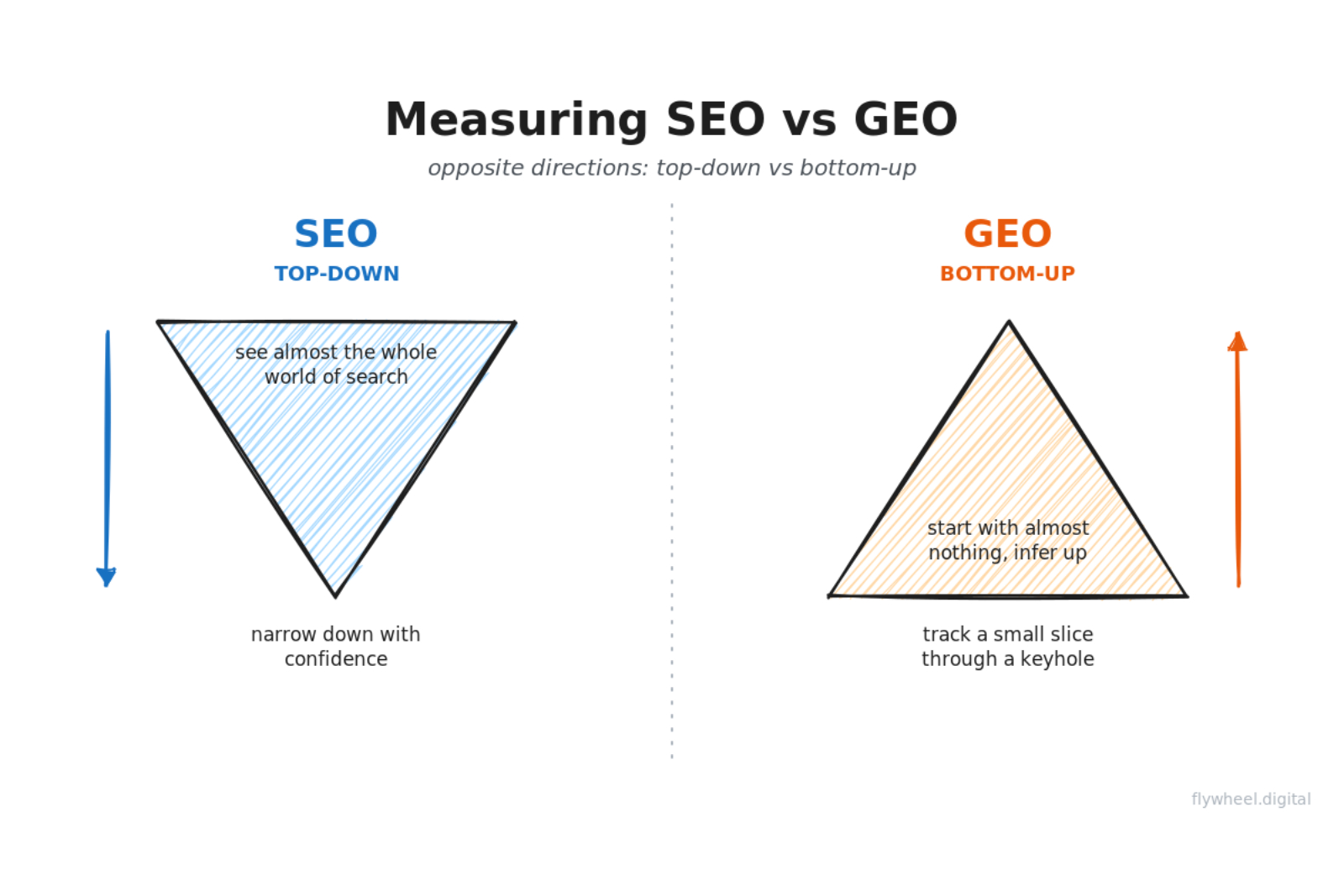
Generative engine optimization tools all start from the same job. They repeatedly query AI assistants, then track and categorize how often your brand shows up for the prompts you care about. That is the core of nearly every tool on the market. Everything else is built on top of it.
If you have used a SEO rank tracker, the shape is familiar. The difference is what gets queried and how unsettled the whole field still is.
What a GEO tool actually does
A GEO tool acts as a third party sitting between you and the AI platforms. It runs your prompts against different AI tools on a schedule, records how your brand appears, and stores the results in its own database so it can spot patterns and trends over time.
From that data it moves into recommendations. It might tell you where the AI is pulling its sources from and suggest you appear in more roundups, publish more on your blog, or build more presence on Reddit. Some tools layer in technical analysis too, flagging pages that are not showing up the way they should.
The job comes down to querying as a third party, seeing what surfaces, and finding patterns that help you understand your performance. What it is NOT is a first-party view. These tools infer your visibility from the outside rather than reading it from the AI platform’s own records.
The four categories of GEO and AI-visibility tools
There are several ways to cut this, but four categories cover the field.
- Analysis and reporting. The core category, the one described above. Tools like Peec.ai and Mentions.so live here, along with many others. There is no clear winner yet.
- Visibility plus content production. Some tools add content generation on top of tracking. Content production is not a visibility strategy on its own, but producing content built to answer AI queries is one way to earn more GEO traffic. Athena is an example: it analyzes how you show up and then uses AI to produce content quickly.
- Visibility bolted onto existing tools. Established platforms are adding AI-visibility features to suites you already use. HubSpot is the clearest case. It already measures, from cookies, how many people visit and convert from AI, and it is now adding a view of how you show up inside AI next to that traffic. Seeing visibility sitting right beside real web traffic is useful.
- First-party platform tools. Analysis that comes straight from the AI platforms themselves. Right now the only real example is Google Search Console, which has begun showing how your brand appears in Gemini. ChatGPT, Claude, and the rest have no Search Console equivalent yet, which is exactly why the whole field leans on third-party tools that query and infer.
What to check before you buy
A few things separate a useful tool from a dashboard that just reports noise.
Query methodology. This is the core. How do they query, and how often? A tool running your prompts once a month is close to useless. It needs to query every day, if not several times a day.
Fan-outs. A fan-out is the set of related searches around your main prompt, rather than the single prompt typed in verbatim. What people actually want to know is everything adjacent to that prompt. A good tool uses fan-outs.
**Reporting and analysis depth.** Does it stop at “here is how often you appear,” or does it categorize that, push further, and give you analysis and next steps?
Crawl and shopping insight. The strongest tools right now also show how AI crawls your site by reading your server pings, and some are starting to track shopping visibility specifically.
If you only adopt one thing this quarter…
There is no clean way to measure GEO manually, so set expectations there. But there is one thing you can measure, for free, that matters more than any dashboard: how much traffic your site gets from AI tools like ChatGPT and Claude.
Set up a filter for it in Google Analytics or HubSpot. It only takes a few minutes. Once it’s running, you can see the real business impact of people arriving from AI, which is the number that counts. From there you can decide whether a paid tool or an agency is worth it.
Since GEO tools are still settling into their final form, the Flywheel team uses AI agents to build custom tracking frameworks that go beyond basic prompt monitoring. These senior strategists help growth brands turn raw AI visibility data into practical SEO and marketing analytics outcomes.